
The brief that reads everything.
No one can read every channel in the company every week. So we built something that does — and writes back one honest page about what actually moved.
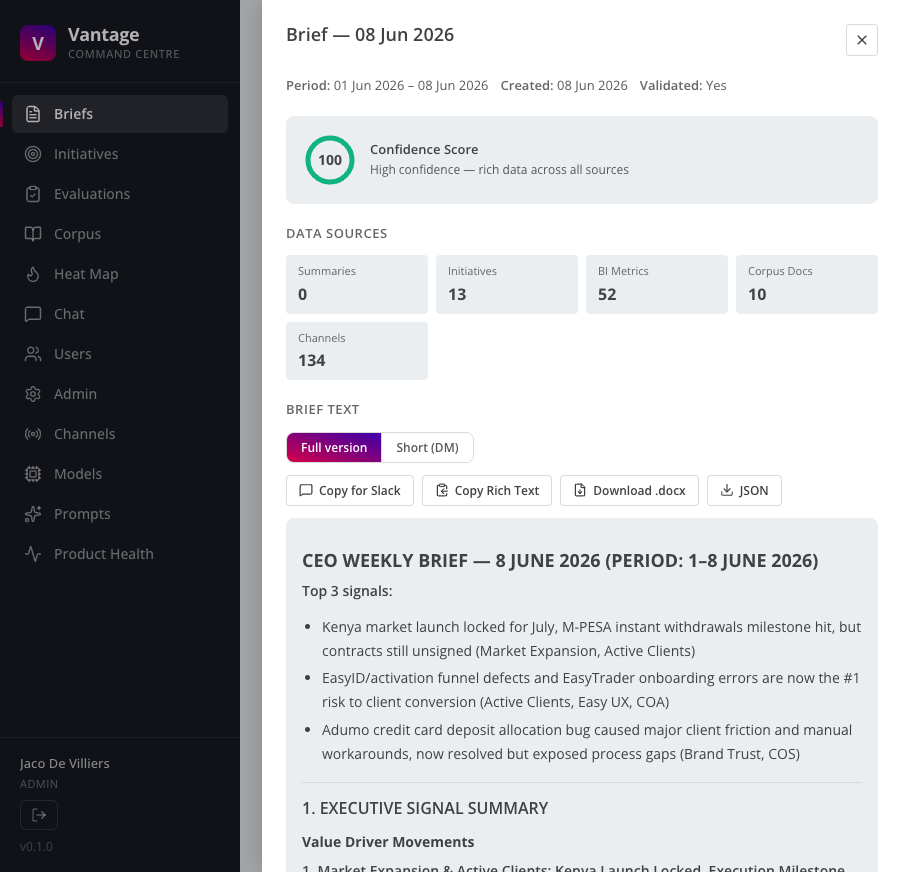
Every Monday, the CEO opens a short brief that read the whole company over the past week. Not a dashboard he has to go and interrogate — an actual written report that fused every Slack channel it's allowed into with the company's strategy and its numbers, and came back with: here's what actually moved value, here's where the plan and the real work have drifted apart, and here's what to do about it. It's called Vantage, and the most important thing about it is the thing it never does: it never names a single person.
That's the heart of it. A company throws off more signal in a week than any executive could ever read — dozens of channels, hundreds of conversations, BI dashboards, incident logs. Vantage reads the firehose so a human doesn't have to, then hands back one calm, ranked, anonymised page. It's a vantage point on the whole business: somewhere high enough to finally see the shape of the week.
And it's the CEO's tool first by design — a place to keep a real pulse on the business and steer it — but it isn't standing still. It's already growing outward, one area at a time. We come back to where it's headed at the end.
Why no one could see the whole company
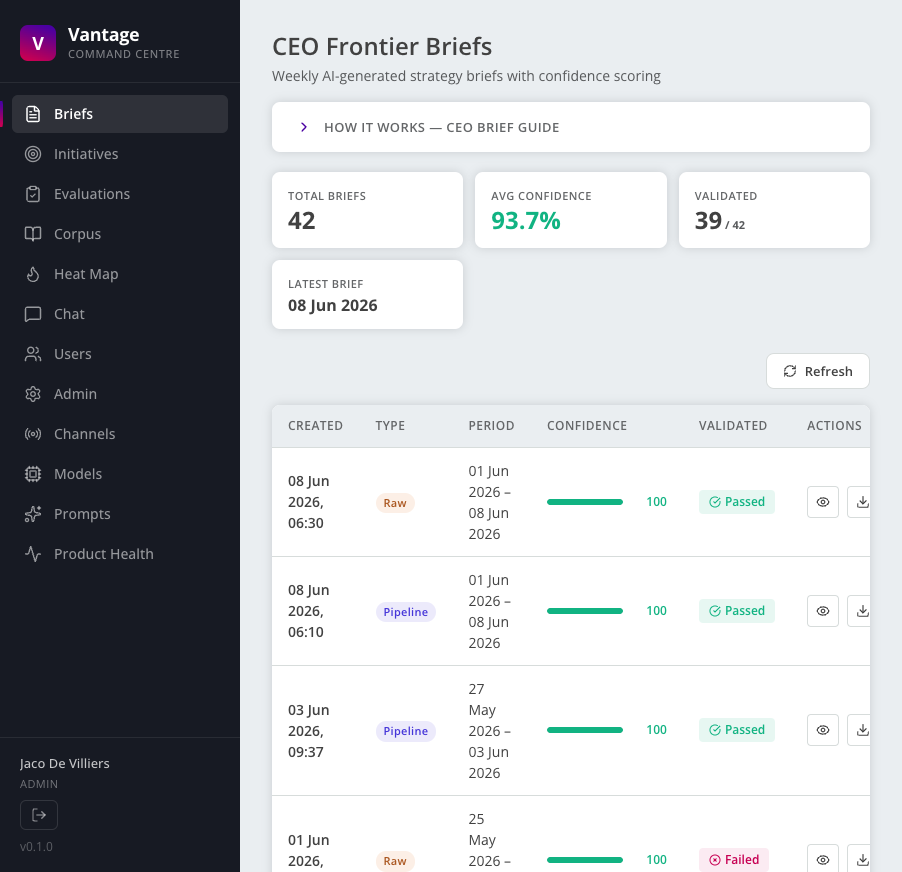
Purple's strategy, its execution and its measurement all live in different places. There are CEO letters and board priorities. There are the forum charters that say who's accountable for what. There are dozens of Slack channels where the actual work happens, hour by hour. And there are BI dashboards with the numbers. Each of those is a window; none of them is the room.
Because the picture is scattered, the honest question — which of the things we said we'd do are actually moving the needle, and which are just busy? — is brutally hard to answer. Status updates tend to be performative. Weak projects survive because nobody holds the full picture long enough to call it. And no single human, the CEO included, can read every channel every week to find out.
That's the gap Vantage was built to close: to connect declared intent (the strategy) to real execution (what's actually happening in the conversations) to value (what genuinely moved) — in one weekly, honest artefact.
How it actually works (for the curious)
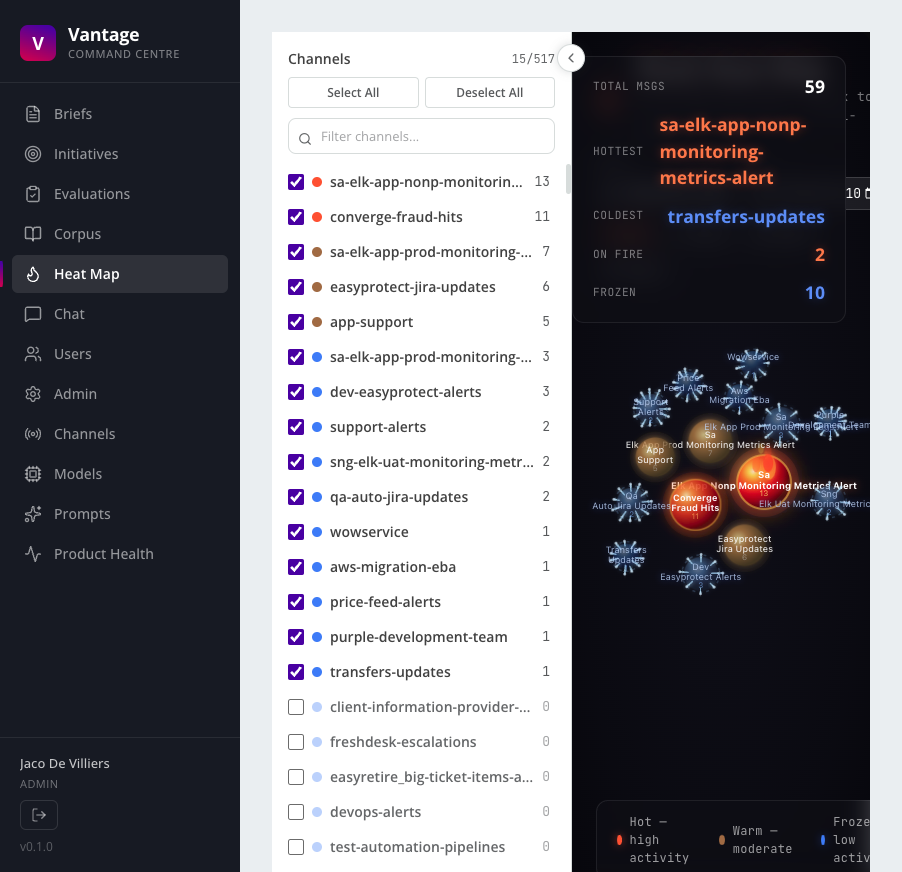
Vantage quietly reads the company's Slack — every channel it's been allowed into — on a poll through the day. It throws away the noise (banter, logistics) and keeps the work-relevant signal, then writes a plain-English summary of each channel, each day. Alongside that it ingests the strategy corpus (the CEO letters, the board's priorities, the forum charters), a hand-curated list of the initiatives the company has actually committed to — each mapped to the value driver it's meant to move — and the numbers from BI.
Once a week, an AI pipeline pulls all of that together and writes the brief: which value drivers moved, where strategy and reality have drifted, a score for each initiative based on real movement rather than activity, a heatmap of where the energy and the silence are, and a short list of suggested interventions. It lands as a Slack DM to the CEO, with the full version (and a machine-readable copy) in the app.
What's in a brief
Every brief is the same five honest sections — written from the company's own conversations, not from anyone's status slide.
Reading everyone's Slack, without watching anyone
Let's name the obvious worry head-on, because it's the right one to have. "It reads every Slack channel" can sound like surveillance. It isn't — and it's built, deliberately and structurally, so that it can't be.
The promises that make this safe
- It reads channels, not people. Every output is attributed by forum or role, never by name. There's a final safety-net scan on the brief itself whose only job is to catch and strip anything that identifies an individual.
- It's read-only, and it judges initiatives — not staff. It is explicitly not an HR or performance tool, and it has no ability to act on your messages.
- It's deliberate and gated. Access is restricted; it ran a 30-day silent calibration before anyone but the CEO saw output; and it requires CISO and Legal sign-off before it ever touches a private channel.
The reframe is the whole point: the company generates more signal in a week than any person can read, so Vantage reads it to tell leadership what moved — and it's constructed so it literally cannot point a finger at a person. The "no names" rule isn't fine print. It's the feature that makes the capability something you can admire instead of fear.
Ask it anything
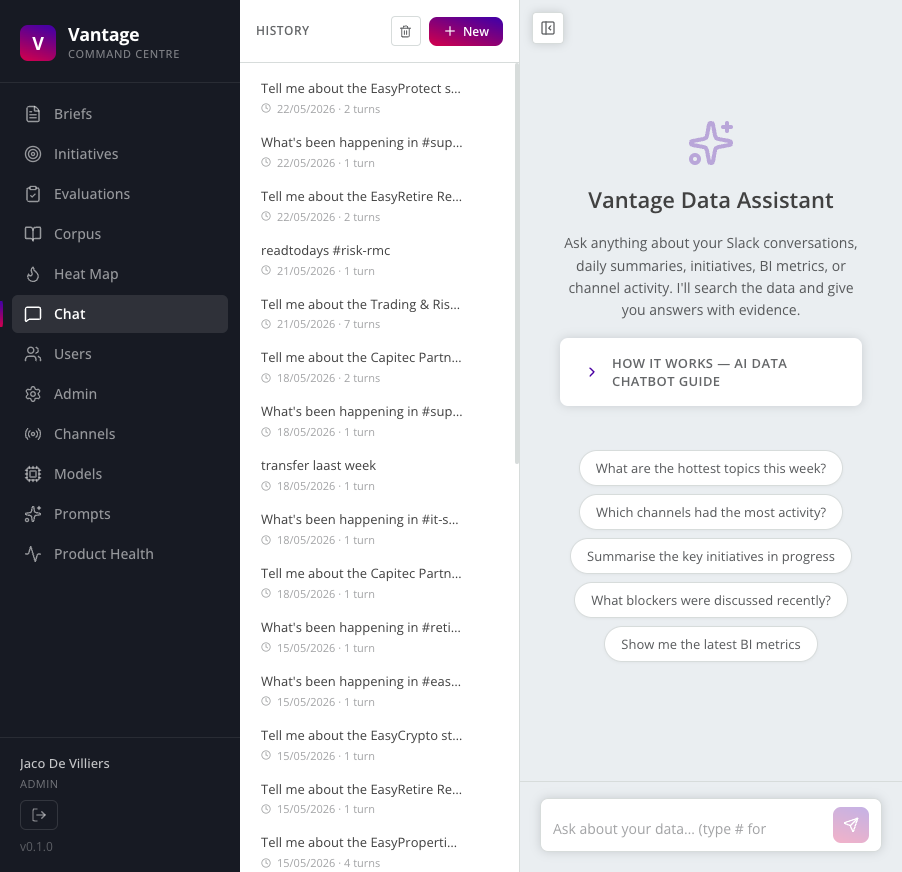
A brief you can't question is just a longer status report. So Vantage talks back. The CEO can reply in Slack — or open the app — and drill into any line: "what's actually blocking that?", "show me the activity behind that score", "summarise what changed on this initiative." It answers from the same evidence the brief was built on, so a single page can unfold into the full story behind any sentence.
From strategy to what actually moved
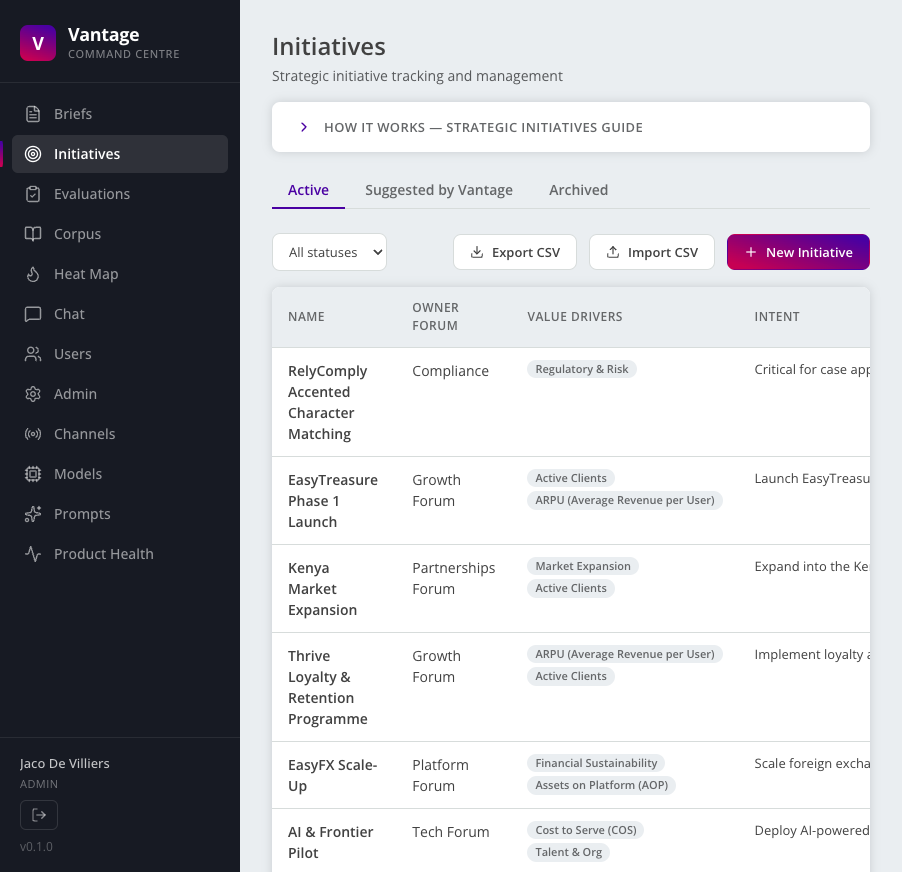
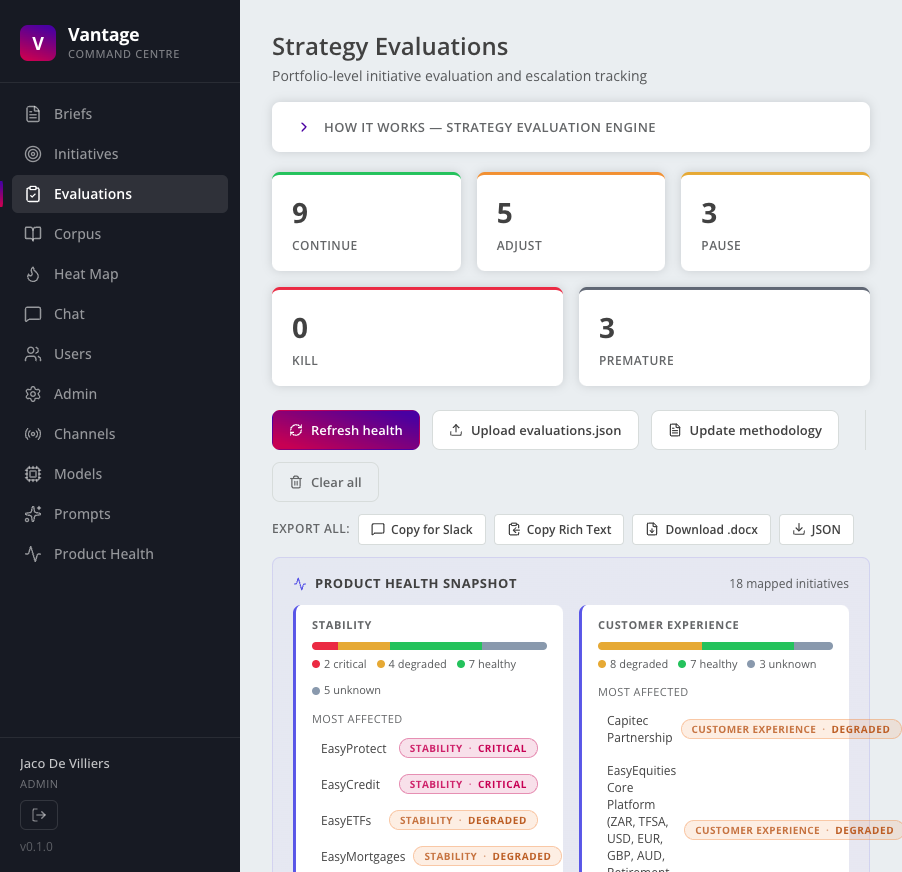
Underneath the weekly brief is the quiet scaffolding that makes it honest. Every initiative the company has committed to is mapped to the value driver it's supposed to move, so "is this working?" has a real answer rather than a vibe. And the harder output is the one most tools avoid: a portfolio view that says, plainly, what to continue, what to adjust, what to pause, and what to kill — alongside a health read on the products underneath. It even proposes initiatives of its own when it spots a pattern the registry has missed.
Built in about three weeks
Here's the part the engineers in the room will want. A system this ambitious — reading all of Slack, fusing it with strategy and BI, scoring initiatives, writing a board-grade brief every week — sounds like a year-long programme with a team behind it. It wasn't.
It was built by essentially one person working with Cursor's AI agents — around four in five of the commits are co-authored by the agents — and a working version was standing up in roughly three weeks of active build. Measured honestly against the plan, that's a speed-up in the order of 10–15×. The method behind that band: the work was scoped at about 180 story points (the better part of a year for one developer at a normal pace), and the active build days in the code's own history come to around a dozen to eighteen — so we quote it as a range, not a single hero number, because story points are estimates and the multiple is only as precise as they are.
And it wasn't built fast and left flaky: a later hardening pass added well over a thousand backend tests plus end-to-end coverage. Fast, then solid.
It's growing — one area at a time
One honest note on where this is. Vantage has been live and in real use for months — for an internal tool like this, the secure Purple-network endpoint is the live one; there's no separate public site we're waiting to flip on. What's deliberately staged is the scope: it's CEO-first by design — a command centre for keeping a pulse on the whole business — and the broader "a vantage point on everything for everyone" version is the direction of travel, earned area by area.
But it is moving outward. The clearest proof isn't a roadmap slide — it's that the same engine is already being pointed at a new question inside EasyProperties: reading the signal around individual properties to help judge whether they're actually good investments. That's the pattern. Vantage started as the CEO's weekly read on the company, and it expands by taking its "read everything, write back one honest answer" trick into one department's hard question at a time.
This isn't a mockup. It's live and in everyday use right now — if you're on the Purple network, go and open it:
The leverage
No leader can read every channel every week — so the real picture of execution stays just out of reach, and attention gets spent on whatever shouts loudest. Vantage reads all of it, anonymises it, and ranks it by what actually moved value, so attention can follow evidence instead of volume. And the meta-point is the same one this whole series keeps making: a system this ambitious now costs weeks, not years, to build. The question to carry forward — what would you decide differently if you could see the honest shape of the week, every week?
It reads the work, never you
If you've ever felt your team's good week disappear into the noise, or watched a busy-but-going- nowhere project soak up attention — this exists to fix exactly that. Vantage reads the work, never the person: no names, no quotes, not for performance. Its whole job is to surface what's quietly important and call out what's merely loud — so the company can steer by what's real.